
在这世界的角落
Will US efforts to deescalate the Israel-Hamas conflict be effective? Experts weigh in_我的网站

一 | Following Hamas' attack on Israel, the United States has sent a clear message of deterrence to prevent the conflict from spreading.To "anyone thinking of taking advantage of this situation," President Joe Biden said during an address on Tuesday, "I have one word: Don't."The rhetoric has since been repeated by others in the administration, with National Security Advisor Jake Sullivan telling reporters that they believe militia groups across the region "pose an urgent threat" and could "choose to try to exploit" the situation.On ABC News Live at 8:30 p.m. on Thursday, Oct. 12, ABC News' James Longman, Matt Gutman and Ian Pannell look at the horrendous toll from Hamas' massacre, the Israelis and Palestinians caught in the middle and what comes next."We have been sending clear warnings that doing so will result in a firm response and consequences from the United States," Sullivan said Tuesday.National Security Council spokesman John Kirby told reporters Wednesday there's a "long list of actors in the region that are hostile to Israel," including Hezbollah, the Iran-backed Lebanese militant group.The administration has also offered its full support to Israel, with Defense Secretary Lloyd Austin telling reporters in Brussels on Thursday that the U.S. is not placing conditions on the military aid it's providing to Israel. The U.S. additionally moved a carrier strike group into the eastern Mediterranean as part of its deterrence measures."We're sending a loud and clear message: The United States is ready to take action should any actor hostile to Israel consider trying to escalate or widen this war," Kirby said Wednesday.How impactful those gestures will be on the raging war remains uncertain. The U.S. has limited leverage in the region, though does need to be careful to not further escalate the conflict, foreign policy experts said. The Biden administration is also likely keen to not get heavily involved, experts said."If Hezbollah or the Islamic Revolutionary Guard Corps or some other militant group from a neighboring country decides to get involved and attack Israel at this time, I don't think the United States is going to do anything more than it's currently doing -- which is offering Israel whatever it needs to defend itself," Ralph Carter, a professor of political science at Texas Christian University, told ABC News.Biden has historically been "cautious" in sending U.S. troops into battle, Carter said. "His experience in Washington over 40 years or more suggests that once you start something like that, you have no idea where it's going to end."Kirby said Thursday that there are no active plans or intentions to send U.S. troops to join a potential ground war in Israel and Gaza. The U.S. has deployed its largest carrier group, the USS Gerald R. Ford, to the region as an act of deterrence, officials said."The United States has moved military assets in the region, but I really do find it doubtful that the Biden administration really wants to get heavily involved militarily," Russell Lucas, a professor of international relations and global studies at Michigan State University, told ABC News.Israel's powerful military is also capable of defending itself against Hamas and other militant groups, experts noted, which may limit what it needs from the U.S. and act as another deterrent."The requirements on the U.S. defense industry I think are maybe not as heavy as they might be if we were talking about a weaker ally," Adria Lawrence, the Aronson Associate Professor of International Studies and Political Science at Johns Hopkins University, said during a public briefing on the conflict.In recent days there have been some limited military engagements on Israel's northern border with Lebanon, though Hezbollah may be deterred from getting drawn into a larger conflict with Israel, experts said."They will pay dearly for entering the conflict," Lucas said. "I think most actors [in the region] know that at the end of the day, the most military-capable actor is Israel, so there is a deterrence factor."Given Israel's known military prowess, the Biden administration's rhetoric may be stronger than necessary, Lucas said."I think it's more the Biden administration is aiming especially at the domestic audience -- trying to reassert that kind of bully pulpit of the commander-in-chief role, especially in the face of perhaps critiques from the Republican Party that Biden isn't strong enough," he said.At the same time, the U.S. does need to be careful about making any threats, experts said."Words matter and if President Biden's making a commitment and making kind of an implicit threat, he needs to remember the risks that are inherent in making a red line," Lucas said. "President Obama's red line in Syria -- do not use chemical weapons -- that was then not followed up was viewed as one of Obama's biggest foreign policy failures."Sarah Parkinson, the Aronson Assistant Professor of Political Science and International Studies at JHU, said during the university's briefing that these comments by U.S. officials "will likely embolden extremists on both sides" and prolong the conflict.Following Biden's remarks, Hezbollah said they will not back down and are "ready for confrontation," while the top leader of the Islamist armed organization Houthis in Yemen said that if the U.S. intervenes militarily in Gaza, they will send munitions and fighters to support Hamas.In efforts to deescalate the conflict, the U.S. could help mobilize other countries in the region, according to James Steinberg, the dean of the School of Advanced International Studies at JHU and former Deputy Secretary of State during the Obama administration."It's not that the United States itself is going to broker a resolution of this, but it can engage others, all of whom have a stake in not seeing the situation escalate," Steinberg said during the university's briefing, noting the discussions that have been taking place between the U.S. and Saudi Arabia, the UAE and others.Secretary of State Antony Blinken told reporters Thursday at a press conference in Israel that they are working with their partners in the region to ensure "that there will not be a second front or a third front."Steinberg said a wider war "can't be ruled out," and the effectiveness of the U.S.' response to deescalate is "uncertain" -- likening it to its support of Israel in 1973 during the Yom Kippur War."Here as then, the United States has limited impact and limited leverage," he said. "Perhaps even less so today than it did in 1973."。
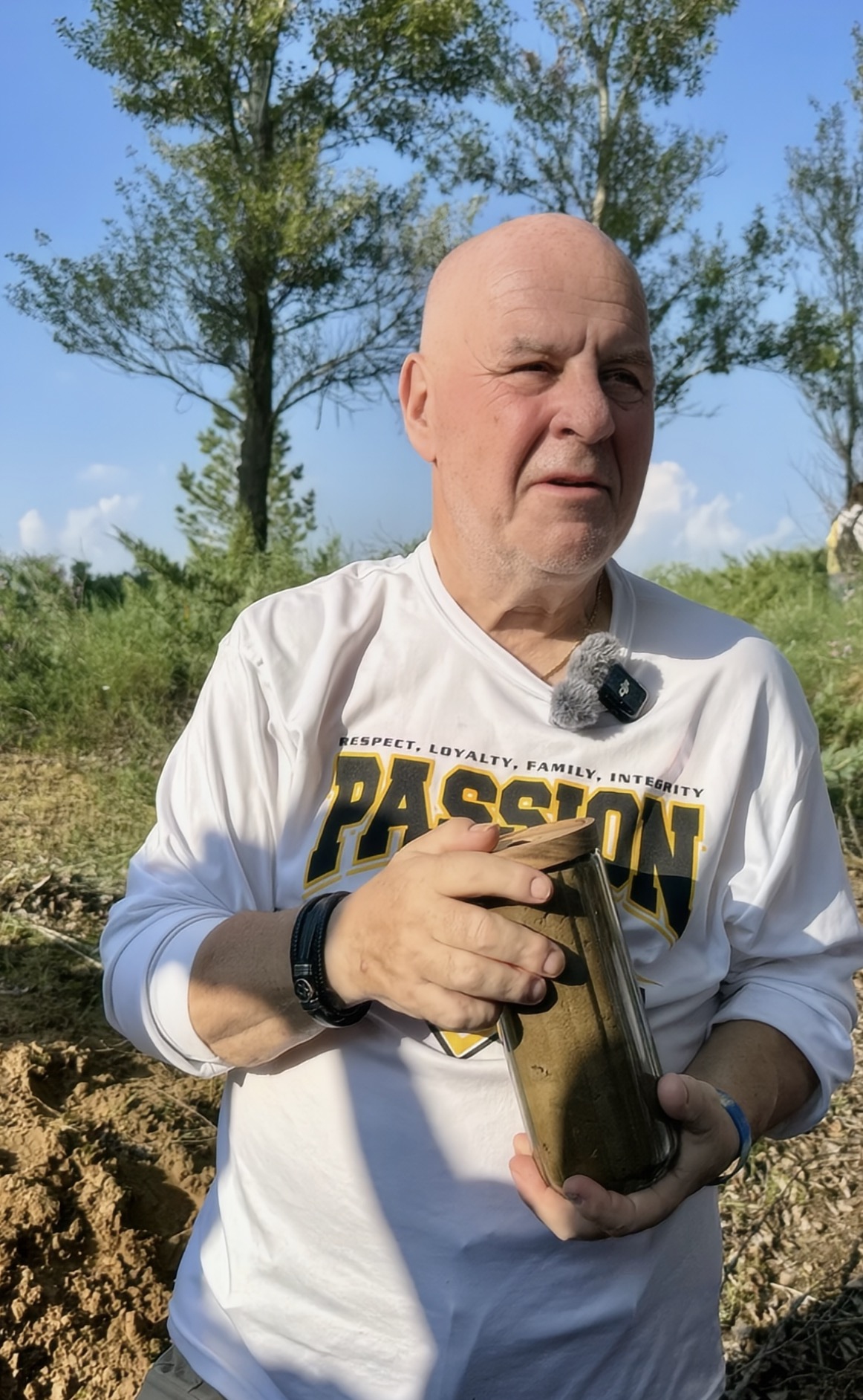
On Monday afternoon, Ronald Sakolsky, an American teacher, set foot once again on the soil of the Mu Us Desert, in the Uxin Banner of Ordos, North China’s Inner Mongolia Autonomous Region. He first came here in 2000. Back then, the land was little more than drifting sand. Today, it is green with trees – a transformation driven by decades of local effort.
He stood within Sakolsky Forest, a woodland formally named to honor his early donation toward local ecological restoration. There, he carried out a plan he had held long before this trip: filling a jar with sand from the desert to bring home to the US.
More than two decades ago, sand was the one thing this place had in abundance. In 1999, when Sakolsky arrived in China as a participant in a bilateral teacher exchange program, he was moved by the tireless efforts of Chinese desert fighter Yin Yuzhen and her husband to curb desertification in the Mu Us Desert. He raised $5,000 – equivalent in 1999 to three years of income for Yin’s entire family – to fund their local tree-planting initiative.
The young saplings bought with that donation have since matured into more than 50,000 full-grown trees, transforming the once desolate, sandy wasteland into a thriving green landscape.
When Sakolsky met Yin at the airport on Sunday, 26 years after his first visit to Inner Mongolia, he joked that he could not take a tree from the Mu Us Desert, but he could slip some sand into his shoes and carry a piece of the land back with him. Now, he had found exactly the sand he wanted – not just any sand, but from a place where persistence had turned desert into life, and where his own name had become part of that story.
“Promise is a promise,” he said. “Ms. Yin made a promise, and she fulfilled it.”
For Sakolsky, the sand is not just dirt. It is a metaphor, a bridge, a shared ground. He plans to tell his grandchildren what it means. “It’s not just a piece of sand in the jar,” he said. “It’s a jar of love.”
He used the jar of sand to symbolize that America and China share a relationship rooted in the same soil. He shook the jar, holding its two ends as if they were the two countries, and said that it shows we’re all on the same planet.
There is an old American joke, he noted, that if you dig a hole deep enough, you will eventually reach China. “We’re all on the same planet,” he said.
Earlier that day, while visiting Yin’s home, he spoke about the need for Americans and Chinese to see each other as family. “All Americans should understand that Chinese people and Americans can be family,” he said. “We can transcend differences if we focus on our common ground. We all love our countries, and we all value loyalty and respect – these are the shared virtues we hold dear.”
As for the sand he collected, Sakolsky said he would treat it as a treasure, alongside all his other precious keepsakes from China. He expects to display it in his living room – a daily reminder of the forest that carries his name and the people who made it grow.
。
Current article:http://ma0zp.yukujuankewazuhangfei.sbs/z3c26wa/20260826/29366.html
Published on:01:39:34
- 上一篇:奇才曾追求德罗赞与威少 最终交易拿下特雷·曼恩
- 下一篇:华为将发布新一代三折叠
我的网站最近更新
- 悬浮、朝圣、难复制,胖东来做成了景区生意
- 《GTA6》葱哥粉丝线下嘲讽R星!拿着根韭葱在公司门口喊话
- 区纪委监委:以强监督守护学生“盘中餐”
- 主播说雄安|未来生活样板长啥样?
- 美国为以色列拉法之战划出两条红线:如何保护平民 如何战后治理
- 扣非增长800%,在手订单超过48亿,这家半导体设备为何狂飙?| 1105 张博划重点
- 我国将构建约6万公里精品自驾旅游公路
- लखनऊ में मेट्रो स्टेशन से उबर बाइक बुक करने पर मिलेगी 50 प्रतिशत की छूट, UPMRC का दिल खुश कर देने वाला फैसला
- 社区Mod转正:CHERRY MX推出官方版Ergo Clear键轴
- 名记:汉迪给纳斯助力 能与詹姆斯建立良好关系
- 前绿党议员入店行窃细节披露:她偷了什么?怎么偷的?
- Ponsonby枪击案:嫌疑人“极其危险”,随便朝人开枪,照片公布
- 高速路衍经济篇:福建高速交旅融合在霞浦
- 暴雨+强对流双预警齐发 部分地区将有10级以上雷暴大风
- 毛利党发起全国示威,抗议政府的变革,明天一早奥克兰三条高速或受阻
- 推动人工智能技术更加有力驱动加快建设交通强国
- 所遇皆福,一遇良人岁岁纳福,山东福彩以福礼贺七夕
- 印军将领脱下军装后,才敢公开说真话,但他还是低估了中印差距,尖锋视野,原创 印军将领脱下军装后,才敢公开说真话,但他还是低估了中印差距
- 御港园|童心飞扬,安全护航
- “黄河溯源·鲁青同心”援青旅游专列首发
- 处暑时节战不熄《全球使命3》VIP特惠豪礼不停
- 来了!《昭和米国物语》新预告:翘臀女主超燃战斗技
- 达卯科技全栈式算电协同服务在闽落子
- 今年上半年中国重点钢铁企业累计营收3.05万亿元,今年上半年中国重点钢铁企业累计营收3.05万亿元
我的网站热门资讯
- Chinese Embassy in Thailand issues reminder to nationals participating in cultural and sports activities in Thailand
- 摩托车疑被藏毒 越堤族及时发现两粒毒丸急报警
- 斯诺克世锦赛:赵心童10-4击败上届亚军杰克-琼斯晋级16强
- 全新别克GL8陆上公务舱上市 22.99万 双层声学玻璃/二排贵宾座椅
- 5年1.25亿,布劳恩的合同,到底是怎么签下的?
- China's CPI edges up 0.5% year on year in July
- 福建多地开展扫码缴费弹窗广告发布行为专项治理 让扫码缴费回归便民本位
- Vivo X23幻影手机一个月
- 新加坡公积金局:非公民和非永久居民户头已关闭!请尽快领取存款
- Shams:海史密斯一年合同回归太阳 上季打7场
- 活力中国调研行|仿生电子皮肤 为机器赋予“触觉感知”
- 南通大学杏林学院昆韵予安实践团开展“雅韵润少年,昆声传文脉”主题宣讲活动
- Rise in violent incidents at NCR condos
- 性别战争一年后,二游市场基本盘依然稳固
- 央行:8月12日7天期逆回购操作量为零
- 抚顺日报社“学雷锋惠民联盟”走进新抚区新抚街道新顺社区
- 捷成股份:本次计提资产减值准备将减少公司2026年半年度合并财务报表归属于上市公司股东的净利润约3878万元
- 长鑫科技:首次公开发行超额配售选择权全额行使
- 拒绝2年合同,威少啊威少,本可以不退役的?
- 凤凰直击俄乌战局:乌军在册女兵超55000人
- 汽车之家股价暴跌近14%:消息称,由于价格上涨,汽车经销商受到限制。
- 隆多分析詹皇加盟76人的原因:另外几队问题明显,费城两人是关键
- 首条跨京冀城市轨道交通线路开启空载试运行,首条跨京冀城市轨道交通线路开启空载试运行
- 小电视废料质量:Bilbili动画旧版和概念版应用程序现在只能选择清晰流畅的质量。